- Organisation: PSI, Global Services Hub
- Period: 2021 to 2024, as DHIS2 Specialist
- My role: co-led the localization and migration of five country server instances into national government ownership
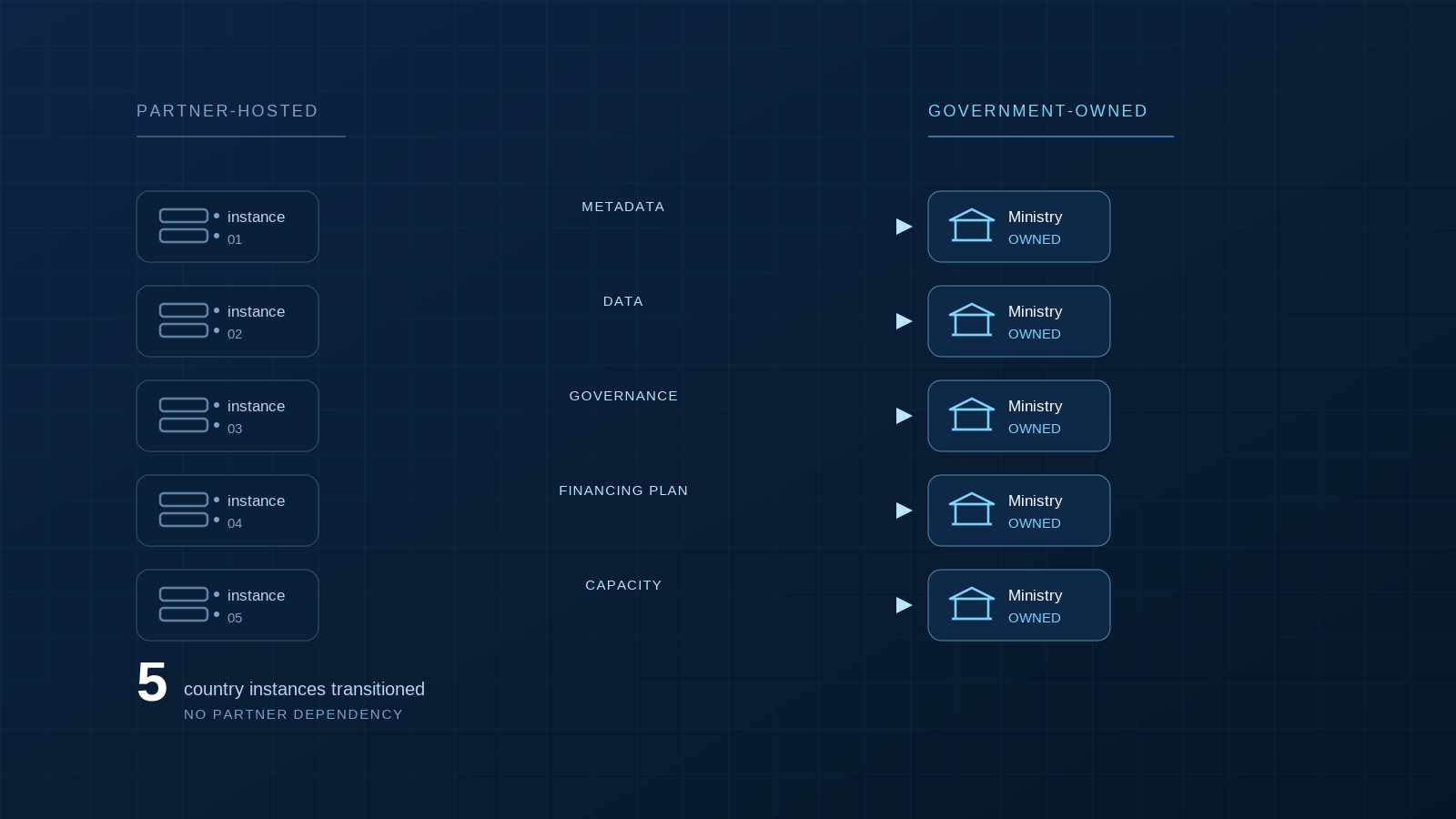
- Moved across: metadata, data, governance structures, sustainable financing plans and long-term operational plans
The problem
Partner-run systems are easy to start and hard to hand over. A DHIS2 instance hosted and maintained by an implementing partner works well while the partner is there. When the project ends, the ministry inherits a server it did not configure, metadata it did not design, and costs nobody budgeted for. The system then either decays or stays dependent on the partner.
What I did
- Localized each instance, so it belonged to the country rather than to a project.
- Migrated metadata and data into government-owned instances.
- Transferred governance: the structures that decide who maintains the system, who approves changes and who supports users.
- Planned the financing, with sustainable financing and long-term operational plans, because a system without a budget line is only borrowed.
- Built capacity alongside the move. Across my career I have trained more than 280 Ministry of Health staff to manage and sustain their own systems.
What the handover was for
The point of every step was that each ministry could run its own DHIS2 system without depending on the partner that started it: on its own budget, under its own governance, with its own staff able to maintain it.
What I would tell the next team
Plan the handover at the start of a project, not the end. Financing and governance take longer to move than data. A migration that moves the server but not the decisions has only moved the problem. And judge it by what the ministry can do alone a year later, not by the date the server changed hands.